Patios & paths · Yorkshire
Patios and pathways in Yorkshire, laid on a full bed
Indian sandstone, porcelain and natural Yorkshire stone patios, every slab primed and bedded on full mortar, with falls that carry water away from your house. Free survey within 3 working days and a 10-year written guarantee.
From £85/m²Usually 3–5 days on site
Overview
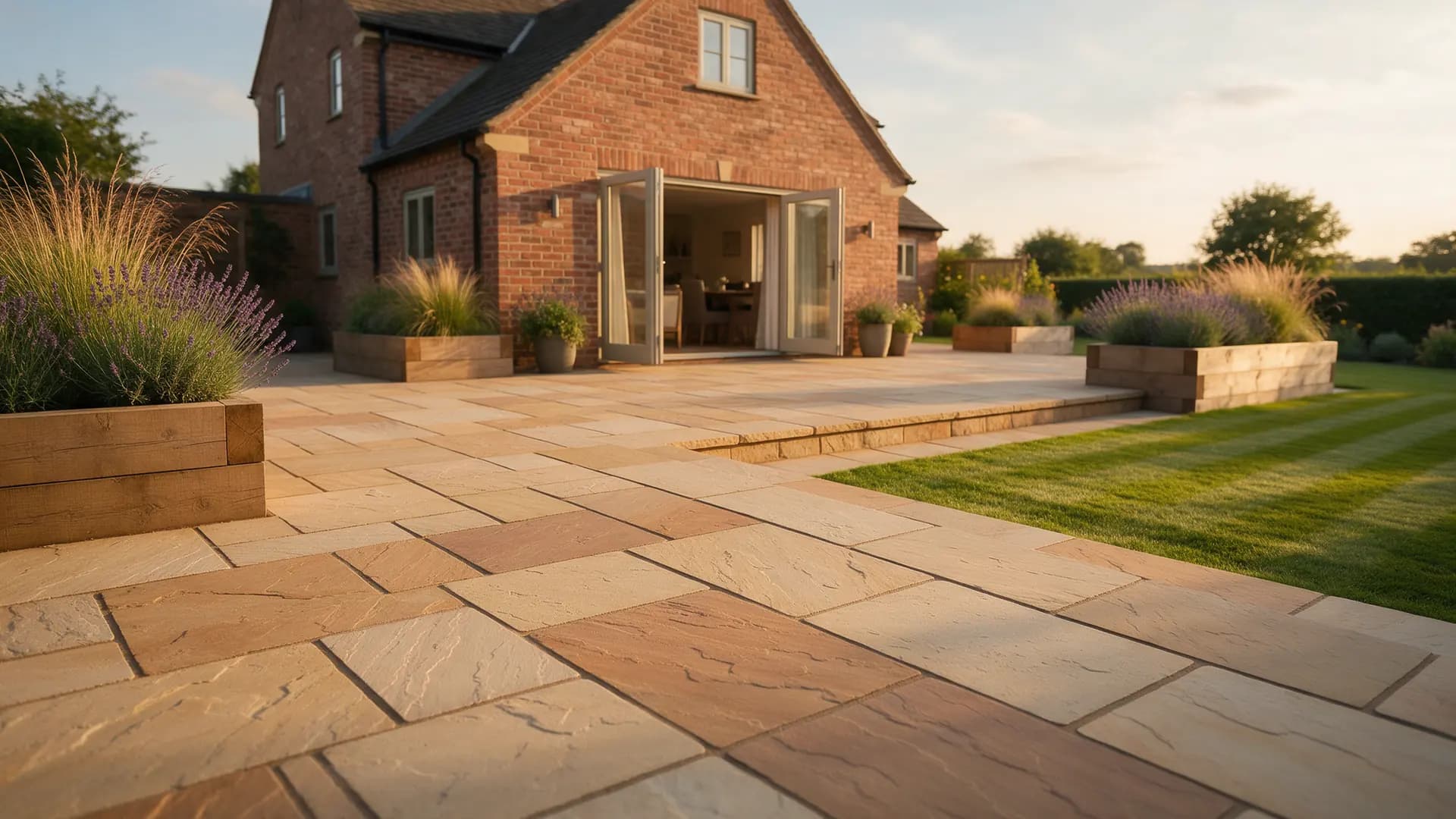
A patio is built for living on rather than parking on, so it’s constructed differently from a driveway: around 100mm of compacted MOT Type 1, a full bed of mortar, and slabs chosen for how they look, feel underfoot and age. We lay Indian sandstone, porcelain and natural Yorkshire stone, along with the paths and steps that tie a garden together. The stone-built houses of Halifax and the Pennine towns suit natural stone particularly well.
Each material has its trade-offs. Porcelain gives a clean, uniform look and shrugs off stains, but it needs diamond cutting and a primer, which adds labour. Indian sandstone has natural variation and gentle texture at a lower material cost, though it weathers and benefits from sealing. Yorkshire stone is the traditional local choice and costs the most, yet a well-laid Yorkshire stone patio lasts for generations.
The commonest shortcut is ‘dot and dab’: slabs set on five spots of mortar instead of a full bed. It’s quicker, but it leaves hollows underneath, so slabs rock, crack under a heavy planter and trap water that stains the stone. The other is level. A patio should finish at least 150mm below your damp-proof course and fall gently away from the house, typically 1 in 60 to 1 in 80, so rain never runs back towards the walls.
Every slab we lay is primed on the back and bedded on a full mortar bed, with the falls set out by string line before the first slab goes down. Where levels near the house are tight, we fit a linear drain rather than bridge the damp-proof course. Read how we work for the full process, or our guide to block paving, resin and tarmac if your project includes a new drive too.
Specification
The numbers that matter
- Typical lifespan
- 25 years or more; natural stone far longer
- Sub-base and bed
- 100mm MOT Type 1 + a full mortar bed
- Slabs
- Sandstone around 22mm calibrated; porcelain 20mm
- Falls and levels
- 1:60–1:80 away from the house; 150mm below DPC
- Ready to walk on
- Usually after 24–48 hours
- Time on site (25 m²)
- 3–5 days
The build
How we build it
A patio sits right against your house, so levels and drainage matter as much as the stone. This is how we build one.

Design, levels and setting out
We agree the shape, size and stone, then take levels from your damp-proof course and air bricks. Falls, drains, steps and edges are marked out with string lines before anything is dug.
Dig out and dispose
Turf, soil or old slabs are removed to around 150–200mm below the finished level, depending on the slab and bed. Spoil leaves with a registered waste carrier, never piled in a corner of your garden.
Compacted sub-base
Around 100mm of MOT Type 1 is laid and compacted with a plate compactor, following the falls. On soft or made-up ground we dig deeper and add more stone.
Edges, steps and drainage
Edge restraints, step foundations and any linear drain by the house go in now. Where levels are tight against the wall, a drain lets the patio sit lower without bridging the damp-proof course.
Prime every slab
A slurry primer is brushed onto the back of each slab just before it’s laid. On porcelain it’s essential, because the material has almost no pores; on sandstone it improves the bond.
Lay on a full bed
Each slab is bedded on a full bed of mortar and tapped down with a rubber mallet, then checked for level, falls and lips between slabs. Cuts are made wet with a diamond blade for clean edges.
Point, clean and hand over
Once the bed has set, the joints are filled with a brush-in jointing compound or a traditional mortar mix to suit the stone. We clean down, walk the patio with you and leave care advice.
Finishes
Colours and finishes
Natural stone varies from slab to slab, which is much of its appeal. These are popular choices for Yorkshire gardens; we bring samples so you can see them in your own light.
Colours on screen are a guide — we bring real samples to your survey.
Kandla Grey sandstone
Cool silver-grey; a modern classic
Raj Green sandstone
Grey-green with rust and buff tones
Autumn Brown sandstone
Warm browns, golds and plum
Mint sandstone
Cream with pale mint and buff tints
Grey porcelain
Uniform, stain-resistant, crisp lines
Natural Yorkshire stone
Buff to grey-brown; the traditional local stone
Price guide
What it costs
Indian sandstone
- Per m²
- £85–£120
- Typical jobfor about 25 m²
- £2,100–£3,000
Porcelain
- Per m²
- £100–£145
- Typical jobfor about 25 m²
- £2,500–£3,650
Natural Yorkshire stone
- Per m²
- £130–£190
- Typical jobfor about 25 m²
- £3,250–£4,750
| Option | Per m² | Typical job |
|---|---|---|
| Indian sandstone | £85–£120 | £2,100–£3,000for about 25 m² |
| Porcelain | £100–£145 | £2,500–£3,650for about 25 m² |
| Natural Yorkshire stone | £130–£190 | £3,250–£4,750for about 25 m² |
Estimate your project
Guide price
£2,100 to £3,000
Guide price · typically 3–5 days
25 m² · Indian sandstone
Rather talk it through? Call 07957 236658
An honest guide, not a quote. Levels, ground conditions and access all affect the final figure, so we always survey before giving you a fixed price in writing.
Guide price £2,100 to £3,000.
Aftercare
Looking after it
Good stone needs very little, but a few habits keep a patio looking as good as the day it was laid.
- Sweep regularly and clear fallen leaves before they stain the stone.
- Clean sandstone with a soft brush and a stone-safe cleaner; acid-based cleaners can mark it.
- If you pressure wash, use a fan nozzle at an angle so you don’t erode the joints.
- Seal sandstone only once the mortar has cured and the stone is fully dry, usually after a few weeks.
- Wipe up wine, oil and barbecue fat promptly, especially on natural stone.
- Stand plant pots on feet so water drains away instead of leaving rings.
Questions
Patios & paths: your questions
Porcelain or Indian sandstone: which should I choose?
Porcelain is uniform, very stain-resistant and needs little care, but it costs more to buy and lay because it needs diamond cutting and a primer. Sandstone has natural variation and texture, costs less and suits older properties, but it weathers, can stain and benefits from sealing. If you want crisp and modern, porcelain; if you want character, stone.
Why do you insist on a full mortar bed?
Because ‘dot and dab’, setting slabs on five spots of mortar, leaves hollows underneath. Hollow slabs rock, crack under heavy pots or furniture and trap water that seeps into the stone and leaves dark stains. A full bed supports the whole slab, spreads the load and keeps water moving off the surface. It takes longer and uses more mortar, and it’s worth it.
How far below the damp-proof course should a patio be?
At least 150mm, roughly two brick courses, and falling away from the house. A patio any higher lets rain splash above the damp-proof course and can push damp into your walls, while covering air bricks blocks the ventilation under suspended floors. Where levels are tight, we fit a linear drain along the house rather than bridge the damp-proof course.
Do I need planning permission for a patio?
Usually not for a ground-level patio in the back garden. You will if it’s raised more than 30cm above the ground, and front-garden paving over 5 m² must be permeable or drain to a permeable area. If your home is listed or in a conservation area, or you live in a flat, check with the council first; we’ll flag it at the survey.
Can you build steps, paths and level changes too?
Yes. Few Yorkshire gardens are flat, so steps, paths and retaining edges are part of most patio jobs. We build steps on concrete foundations with even risers and generous treads, and match paths to the patio stone so the garden reads as one design rather than a collection of bits.
Why has my new sandstone patio got white marks?
That’s usually efflorescence: natural salts drawn out of the mortar and stone as they dry, leaving a white bloom. It’s harmless and normally washes away with rain over a few months. Don’t attack it with acid cleaners, which can damage the stone; a soft brush is enough. Marks that persist beyond a year are worth showing us.
Also consider
Related services


Free quote
A fixed price, after a free survey
Tell us what you have in mind and we’ll arrange a visit. You’ll get a fixed written quote, a 10-year guarantee and no pressure to decide.
Free survey · fixed written quote · no pressure